If you run a small business, there is a good chance Zapier already does some of your work. A new form entry becomes a row in a sheet. A paid invoice posts a message in Slack. A new customer gets a welcome email. It is reliable, it runs in the cloud all day, and once it is set up you forget it exists.
So when people hear about AI agents, a sensible question follows: is this just Zapier with a chatbot on top? And if not, which should do what?
The short version: Zapier runs recipes. Agents make judgment calls. Most businesses need both, and the trick is knowing which job is which.
What a recipe is good at
A Zapier workflow is a fixed recipe. When this happens, do that, then that. Every run follows the same steps, in the same order, with the same fields.
That is exactly what you want when:
- The input is structured, like a form, a payment or a new row.
- The right action never changes, like copying a field or sending a template.
- A mistake would be expensive, and you want the same result every time.
- It has to run at 3am whether or not anyone's computer is on.
Zapier has added AI steps and its own agents too, and they are worth a look. But the core strength is the recipe, and for recipe-shaped work, it is hard to beat.
Where recipes break
Recipes struggle when the input is messy, or the right action depends on reading it.
- An email that could be a complaint, a sales lead or a supplier invoice.
- A contract that needs someone to notice the one unusual clause.
- Meeting notes that hide three promises and a deadline.
- A competitor's pricing page that changed in a way no field captures.
- A weekly report where the useful part is "what should I worry about".
You can build branches and filters for some of this, but every branch is a guess you made in advance. When the email doesn't fit any branch, the recipe either does the wrong thing or nothing.
What an agent adds
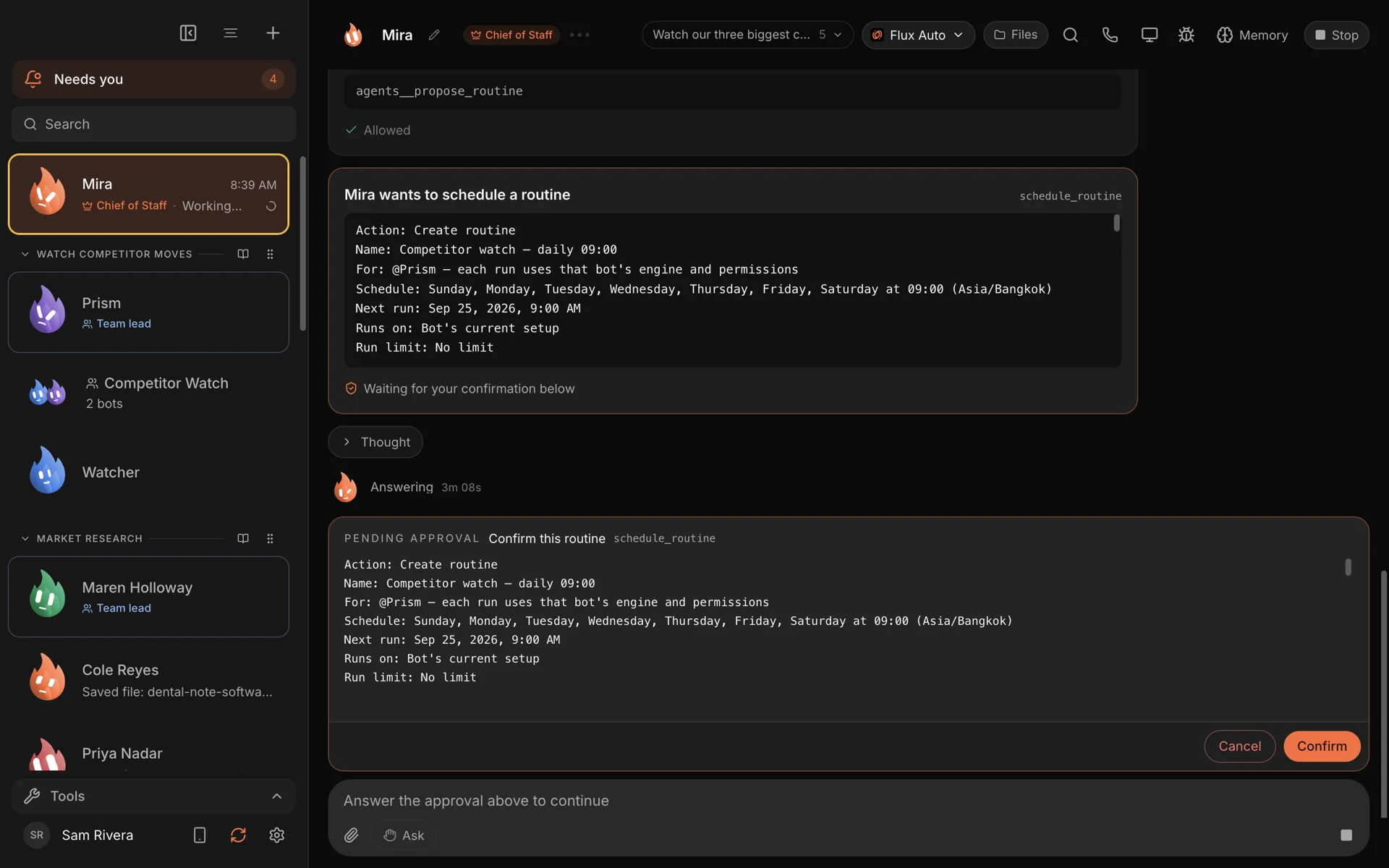
An AI agent reads the input, decides what it is, and chooses what to do. In Murage, that work is done by a team of bots under your Chief of Staff. You describe the outcome in plain words instead of wiring up steps:
Every weekday at 8, read what came into the support inbox overnight.
Sort it into complaints, sales questions and everything else.
Draft replies for the routine ones. Flag the complaints for me.
The Chief proposes the routine, and nothing is scheduled until you choose Confirm. The bots use judgment on each message, and they remember what you have told them about your customers and your tone.
The difference that matters most: an agent can decide, but it should also ask. New bots in Murage start on Ask, so they check with you before they act. On Full access, a bot stops before messaging anyone new, posting publicly, paying, or deleting outside its folder, unless you have allowed it for that task. On Hermes and other ACP engines, Ask and the stop line cover only what the engine asks Murage about: shell commands and file edits. See approvals and the stop line.
A simple way to sort your jobs
Ask two questions about any piece of work.
Is the input predictable? A form submission is. An email is not.
Is the right action always the same? Copying a field is. Replying to a customer is not.
- Predictable input and the same action every time: recipe (Zapier).
- Predictable input and an action that depends on reading it: recipe with an AI step, or an agent.
- Messy input and the same action every time: an agent sorts it, and a recipe does the rest.
- Messy input and an action that depends on reading it: an agent.
The bottom-right box is where agents earn their keep: support queues, inboxes, research, reviews, reports and anything that starts with "have a look at this and tell me what you think".
Where Zapier wins, honestly
- Always on. Zapier runs in the cloud around the clock. Murage runs on your computer, so routines run while it is on and Murage is open. A routine up to 12 hours late still runs. A hosted version, Murage Cloud, is planned but not open yet.
- Certainty. A recipe does the same thing every time. An agent is making calls, and it will sometimes make the wrong one.
- Cost per run. A simple recipe step is cheap. An agent reading a long email uses an AI model each time.
Where agents win
- Messy input. They read it instead of matching fields.
- Outcomes, not steps. You describe what you want. No branches to maintain.
- Memory. A team learns your business, your tone and your customers, and you can open and correct what it remembers.
- Many apps at once. One job can pull from your inbox, calendar and notes. Murage connects 1,500+ apps through a Flux Router account or your own connected-apps key.
- Engine choice. Each bot runs on the AI you pick, including the Claude or ChatGPT plan you already pay for.
Use both
The best setups let each do its job. Two ways to join them:
- The agent decides, the recipe executes. The bot sorts and drafts, and you approve. Your existing Zapier recipes keep handling the structured steps downstream, like logging a row or tagging a contact.
- The recipe triggers the agent. Murage can start a bot's task from a webhook. The receiver listens only on your own computer, so a cloud service like Zapier needs your own tunnel to reach it. That is a technical step, but it lets a form submission kick off real work.
Try it on one messy job
Pick the job in your business that keeps breaking your recipes. Usually it is an inbox. Download Murage, start from the Reply Desk team in the team library, and let it draft for a week on Ask. Keep your recipes for everything recipe-shaped.
Zapier is a trademark of Zapier, Inc. Murage is not affiliated with Zapier.