Already running Hermes or OpenClaw? Keep it. Murage makes it better.

This page is for the week you want more than one agent gives you: the inbox, the follow-ups, the month-end numbers and the research that needs sources, done by a team you brief once. Start with what came back from one of those jobs.

Free and open source. macOS, Windows and Ubuntu.

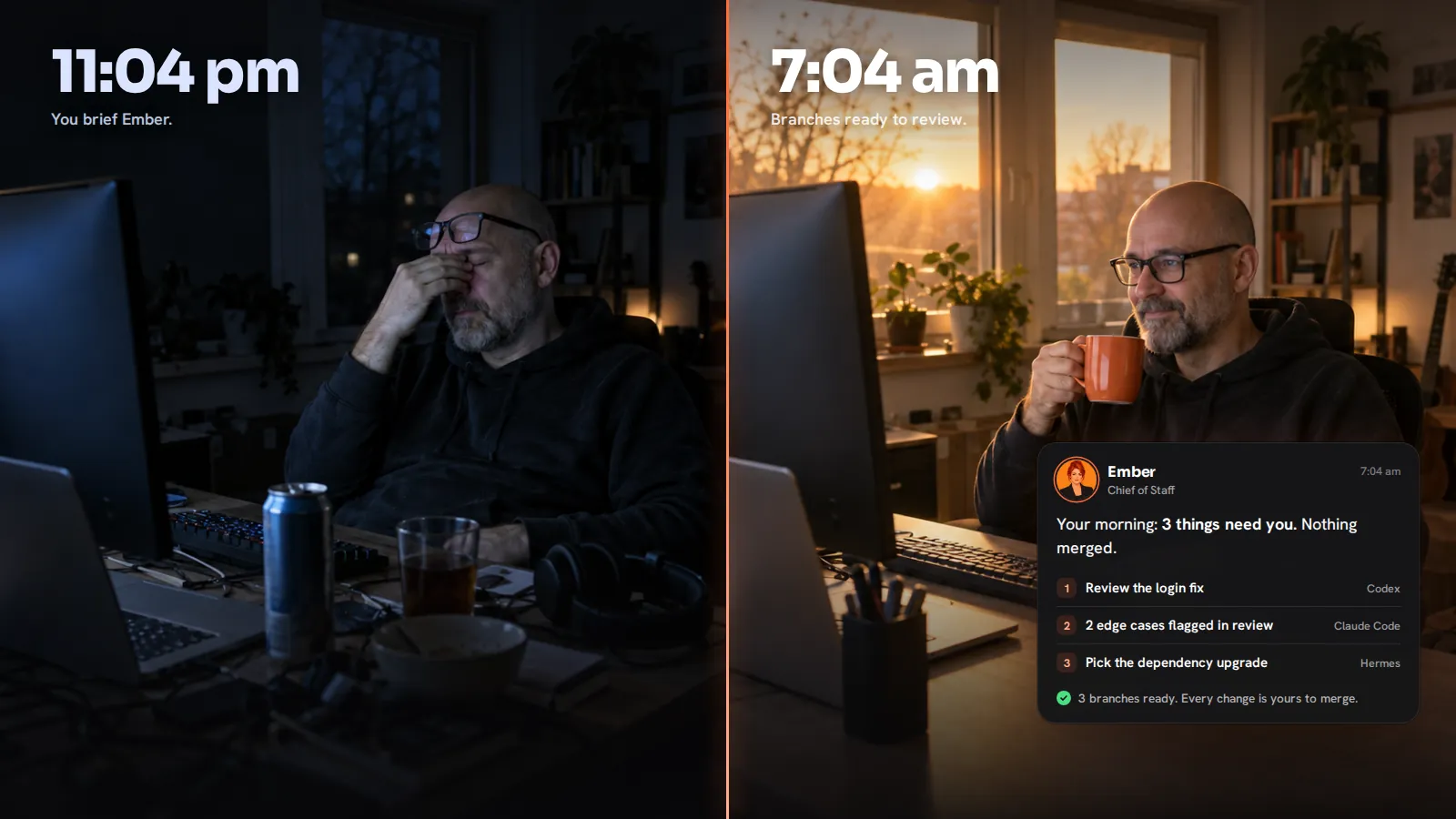
A developer at his desk twice: rubbing his eyes by monitor light at 11pm, then relaxed with coffee at 7am while Ember lists branches from Codex, Claude Code and Hermes ready for his review.
Hand it off at 11pm. Review it at 7am. Codex, Claude Code and Hermes on one team, with your Chief of Staff bringing the results back.

Here’s what came back this morning.

The brief

“Go through my inbox before I get in. Draft replies in my voice. Send nothing.”

What came back

Twelve emails came in. The team drafted eight replies, set four aside, and left two questions only the owner could answer. Nothing was sent.

Needs from you, in the team’s own report

  • Dana Brooks, Acme Studio · RenewalThe prior contract terms
  • Jordan Lee, Brightline Design · Pricing for 20 seatsThe per-seat price, and whether we offer a pilot
  • Priya S. · Export to PDF?Confirm the exact steps
  • Ben C. · Refund requestMoney. Check the billing record first
Replay of a real run on demo data. The company is made up. Engine: Flux Auto, worked 1m 41s. Watch the run

One brief to the Chief of Staff: triage the inbox, draft the replies, send nothing. This is a demo workspace. The company and its emails are made up; the app and what the bots did are real.

Still yours: the per-seat price, Dana’s prior contract terms, Ben’s refund, and pressing Send.

The twelve emails, the team’s report and all eight drafts are published. Read them and decide whether you’d have sent them.

Read the emails, the report and the drafts

What carries over, and what doesn’t.

We don’t care which AI you use. Murage sits above it and runs it as an engine. Here’s exactly what that means for the agent you run now.

Hermes runs inside Murage today

Murage runs the Hermes you already installed, through Hermes’s own ACP adapter, as the engine for any bot you choose. A Hermes bot can start on the model your Hermes is already set to. If Hermes isn’t installed, Murage shows you Nous Research’s one-line install.

Pick a local model for a Hermes bot and Murage adds that model’s provider to your Hermes config.yaml, so Hermes can reach it.

The stop line on a Hermes bot covers what Hermes asks Murage about. Hermes’s ACP adapter asks before shell commands and file edits, but not before MCP or connected-app tools, so let Hermes draft, and put sends through tools you add on a Claude Code or Codex bot.

OpenClaw is coming as an engine

OpenClaw is coming to Murage as a bot’s engine, the way Hermes runs today. Until then they’re separate apps, and you can run both side by side on the same computer.

What doesn’t import

Your Hermes or OpenClaw chat history, memory, skills and settings stay where they are. Murage doesn’t import them.

You set up again: the chat app you message your Chief of Staff from (Telegram, Slack or Discord), the apps your bots connect to, and any standing instructions, which you write once as House Rules or a Team brief.

What a Murage bot keeps

Each bot’s name, notes, skills, routines and approvals live in Murage, on your computer. Change a bot’s engine next month and all of that stays put. The engine’s own session doesn’t move with it.

Claude Code and Codex use the sign-in you already have on this computer. Murage never reads your login.

You know how this usually goes.

The agent says done. You go check. The wrong 10% looks exactly like the right 90%.

Murage doesn’t promise better answers than the engine underneath. Hermes on Murage is the same Hermes. What changes is what reaches you: drafts you check instead of messages sent, a source next to each claim in a research page, and a reviewer bot on any team you want one on. New bots start on Ask. On Full access, a bot stops before messaging anyone new, posting publicly, paying, or deleting outside its folder, unless you have allowed it for that task. On Claude Code and Codex, the stop line also covers tools from MCP servers you add. On Hermes and other ACP engines, Ask and the stop line cover only what the engine asks Murage about: Hermes asks before shell commands and file edits, but not before MCP or connected-app tools.

Side by side, for this move.

Four questions people ask before they switch, answered from each product’s own pages (checked September 25, 2026). The full comparisons have the rest.

Who builds the team

Murage
A Chief of Staff builds and runs a team for each job
OpenClaw
Multi-agent routing that you configure
Hermes
Subagents inside a task

What asks first by default

Murage
New bots start on Ask. On Full access, a bot stops before messaging anyone new, posting publicly, paying, or deleting outside its folder, unless you have allowed it for that task. Replies in an existing conversation go ahead on Auto and Full access. No limits turns the stop line off. On Claude Code and Codex, the stop line also covers tools from MCP servers you add. On Hermes and other ACP engines, Ask and the stop line cover only what the engine asks Murage about: Hermes asks before shell commands and file edits, but not before MCP or connected-app tools.
OpenClaw
Opt-in exec approvals and DM pairing; host commands default to full access
Hermes
Command approvals, container isolation and DM pairing

Where memory lives

Murage
On your computer, open to read and edit
OpenClaw
Markdown files on your disk
Hermes
Persistent memory with search across past sessions

Chat apps that reach you

Murage
Telegram, Slack and Discord for your Chief
OpenClaw
29 channels, including WhatsApp, iMessage and Signal
Hermes
Telegram, Discord, Slack, WhatsApp, Signal and email

Where they’re ahead.

OpenClaw

  • Far more chat apps. 29 channels, including WhatsApp, iMessage and Signal. Murage reaches you on Telegram, Slack and Discord.
  • Real phone calls. A voice-call plugin places phone calls with realtime voice. Murage’s calls happen in the app.
  • More model providers. Dozens of providers. Both run local models; OpenClaw supports more runtimes (vLLM, SGLang).
  • Native phone apps and a huge community. Native iOS and Android apps, about 391,000 GitHub stars (checked September 27, 2026), a nonprofit foundation and the ClawHub plugin marketplace. Murage’s phone app is coming.
Murage and OpenClaw, in full

Hermes Agent

  • More chat apps. WhatsApp, Signal and email as well as Telegram, Discord and Slack.
  • Writes its own skills. Hermes turns experience into skills as it goes. Murage bots can learn skills too (experimental), and each one waits for your Enable click.
  • Runs wherever you host it. Desktop apps for Mac, Windows and Linux, plus servers and Nous Portal’s optional cloud, so it can run around the clock today.
  • Voice with wake words. Voice mode with barge-in and wake words.
Murage and Hermes Agent, in full

Your first week.

Five short steps, each small enough to judge. You can stop after any of them.

  1. Day 1Install, and connect the engine you already use.Download Murage and pick Hermes, Claude Code or Codex for your first bot. New bots start on Ask.
  2. Day 2One job you know well.Brief your Chief of Staff on work whose answer you can check: the weekly report, a research brief, a set of follow-up drafts. Ask for drafts, and write “send nothing” in the brief.
  3. Day 3Add a reviewer.Ask the Chief to add a reviewer bot to the team, with one instruction: check each draft against the brief and list what’s missing.
  4. Day 4Read what came back.Check the work against what you asked for. Open each bot’s notes and fix anything it got wrong; notes are files you can edit or delete.
  5. Day 5Try a routine.Ask for a weekday morning brief. The Chief shows the routine on a card, and nothing is scheduled until you press Confirm.
Day 5 in the real app: a weekday 7:00 morning brief waiting for Confirm before it’s scheduled.

Demo workspace. Your Chief of Staff starts as Ember; you can rename it.

If it isn’t for you.

Stop using it. Your existing agent keeps working as it did, with its own history, because Murage never imported it. The Murage team’s memory and files are stored on your computer in files you can open, and you can export a team to keep it.

The app is free, and the code is AGPL-3.0, so you can read exactly what it did with your files.

What’s open, and how to check itPrivacy and security

One job this week. Judge it yourself.

Download the free app, connect the engine you already use, and brief your Chief of Staff on one job you can check.

No account needed · Runs on the AI plan you already pay for